

New Australian guidelines for the submission of digital mineral exploration data released
The 5th version of the guidelines was released on 23 March 2026.
More information on the new guidelines
In South Australia mineral tenement holders have a statutory requirement to submit reports, data and samples on their exploration activities.
On this page
Digital data submission templates and requirements
Templates for submission of digital data have been updated with DEM requirements for all tenements in South Australia. If you are a tenement manager for multiple companies in South Australia, inform your clients and share the updated templates.
Use the checklist for each file to avoid delay in processing and validation of your data.
An instructional video and PDF give template examples and guidelines.
More information
If further assistance is required contact DEM.GSSAdatacompliance@sa.gov.au
Mineral exploration reporting
In South Australia mineral tenement holders have a statutory requirement to:
- submit reports, data and samples on their exploration activities
- ensure integrity of data
- comply with South Australian Government policies pursuant to the Mining Act 1971 and Mining Regulations 2020.
These requirements are in place to ensure that:
- exploration progress can be assessed in accordance with licence conditions
- data obtained in the course of exploration can be effectively captured to ensure future availability to the exploration industry.
The data must be submitted in digital format and in accordance with the Australian requirements for the submission of digital exploration data and digital data submission templates and requirements outlined above.
Minerals Regulatory Guideline MG13: Mineral exploration reporting has been produced to assist tenement holders in the preparation and submission of statutory reports (that is annual activity summaries, technical and partial surrender reports) for mineral tenements in South Australia.
The guidelines are in line with national standards on the reporting of digital exploration data, and the content of exploration reports. The timely submission of these reports in a standardised format assists the Department for Energy and Mining to deliver effective and efficient regulation and facilitate the timely and efficient release of surrendered ground and data to industry.
MG13: Mineral exploration reporting (PDF, 1 MB)
More information on submitting samples to the Drill Core Library
More about the requirements regarding mineral exploration activities in South Australia
Annual activity (AA) summary
The AA summary forms part of the annual technical report but is required to be submitted on an individual basis based on the anniversary date of the exploration licence.
An AA summary must be completed and lodged online using the MERS Portal. Once the period end date is passed the form will be generated on your MERS Dashboard in the ‘Draft Lodgements’ section and can be completed and submitted from there.
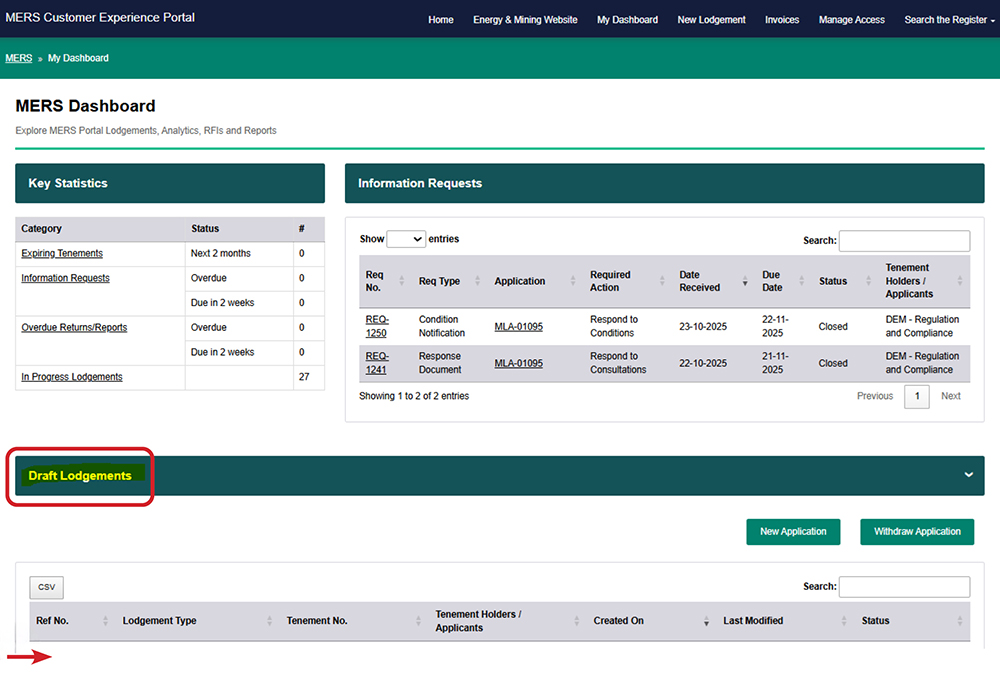
An email report reminder will be sent to the tenement holder / nominated authorised person on the anniversary date, stating that the AA summary is due in 60 days.
Exploration Compliance Report (ECR)
Exploration compliance reports (ECR) will be required for all exploration activities conducted on exploration licences (ELs), mineral claims (MCs) and retention leases (RLs) where an exploration program for environment and rehabilitation (EPEPR) has been approved pursuant to Part 10A of the Mining Act 1971. The reporting periods and minimum information required to be submitted in an ECR is specified in Terms of reference 012: Mineral exploration compliance reports (PDF 483 KB).
Where activities have been conducted in accordance with the Adopted program 001: Generic program for environment protection and rehabilitation - low impact mineral exploration (PDF 491 KB), an ECR is not required. However, the Minister (or delegate) reserves the right to request an ECR for activities conducted in accordance with the generic PEPR for audit purposes, or where there may be reason to believe that the generic PEPR outcomes are not being achieved.
Where an exploration EPEPR has been approved for activities not covered by the generic PEPR, an ECR must be submitted for either:
- each individual EL; or
- a single report covering all tenements included within joint reporting arrangements agreed to with the Minister (or delegate).
An ECR template has been developed to assist explorers to meet the requirements of TOR 012, and to facilitate effective and timely assessment by the department. ECRs must be submitted via the MERS Portal using the following template:
The ECR template will appear in the Draft Lodgements section of the client dashboard when it becomes due.
Notification of an airborne survey
Mining Regulation 80 requires the tenement holder to provide notification of any proposed airborne surveys to the department 14 days prior to undertaking this work.
Notification of an airborne survey is also required to be submitted for airborne surveys which will be carried out using an unmanned aerial vehicle (UAV) or drone.
A notification of an airborne survey on a mineral tenement must be lodged online using Form 32 via the MERS Portal.
Joint (combined) reporting
Where an exploration project is being conducted across adjoining exploration licences and mineral tenements, the tenement holder can apply to the Minister for joint reporting status for those tenements. Such arrangements are encouraged as they reduce the number of reports to be completed by companies and reduce handling by the department.
Requests for joint reporting status must be lodged online using Form 31 via the MERS Portal.
The application must be accompanied by the relevant information as detailed on the form.
National mineral exploration reporting standards
Mineral exploration reporting should conform to the national standard developed by the Geoscience Working Group (GWG). The Australian guidelines for the submission of digital data have been developed to support standardised reporting. The guidelines also provide templates for point located data such as geochemistry and drilling to assist with reporting compliance.
Version 5 of the Australian guidelines, released in March 2026, is a major update and includes:
- formatting updates and terminology clarifications throughout the document
- a significant expansion of the geophysics sections including new sections on airborne geophysical data, remote sensing and hyperspectral data, and revision of the ground geophysical data sections
- the inclusion of petrophysical properties, including templates for surface petrophysical data and downhole petrophysical logs
- guidelines for improved core photography data capture and submission
- updates to the headers and structure of most data submission templates
- removal of the drilling summary template (DU5)
- a new Codes template (CT5).
A more detailed description of the updates is in Appendix 3 of the guidelines.
This is a significant revision of the guidelines and DEM recognises it will take time to adopt these changes. As such South Australia will continue to accept data in accordance with the previous version (4.5) until 1 January 2027.
Access the Australian requirements for the submission of digital data (version 5) PDF 2.1 MB
South Australia has specialised individual requirements in addition to those in the National standards.
Submitting digital reports and data
All reports, notifications and data should be lodged online using the MERS Portal.
For large amounts of data, where possible, groups of files should be separated and uploaded to meet the 250 MB upload limit. Where this is not possible, OneDrive is the preferred platform for transferring information too large to be lodged in MERS. It allows individual folders to be shared with individual users. Where this is required, email DEM.Exploration@sa.gov.au to request a OneDrive file sharing folder.
More information
For advice relating to exploration reports contact DEM.Exploration@sa.gov.au
Exploration Assessment Team
+61 8 8429 2587